
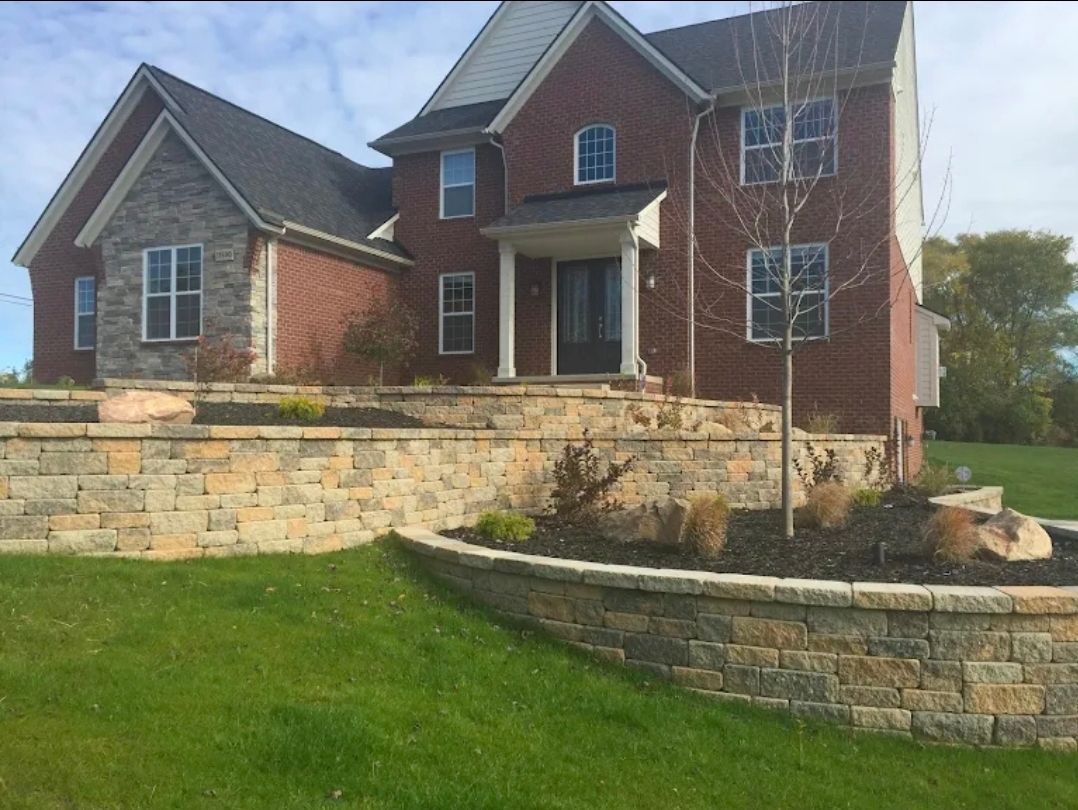
Walls That Hold Slopes Year After Year
Retaining Wall Construction in Macomb for properties with erosion damage, steep grades, and unstable landscape transitions
Slopes that wash out after heavy rain, landscape beds that slump into lower areas, and driveways undermined by shifting soil all point to the need for engineered retaining structures. Retaining walls do more than hold back dirt—they redirect water, protect foundations, and create usable outdoor space on properties where elevation changes would otherwise limit functionality. Scenic Stoneworks LLC designs and builds retaining walls using segmental block systems, natural stone, and engineered solutions selected based on wall height, soil conditions, and drainage requirements specific to each Macomb property.
Wall construction starts with excavation to stable soil or engineered fill, followed by a compacted base that establishes level footing. Drainage aggregate is placed behind the wall to prevent hydrostatic pressure buildup, and perforated pipe at the base collects water and channels it away from the structure. Block units or stone are set with appropriate batter—the backward lean that adds stability—and geogrid reinforcement is integrated into taller walls to tie the structure into the retained soil mass.
Schedule a retaining wall consultation to assess your property's slope conditions and determine the structural requirements for stable, long-term performance.
How Retaining Walls Address Erosion and Slope Failure
Wall systems must account for soil type, groundwater conditions, and the loads imposed by driveways, patios, or structures located above the wall. Segmental retaining wall blocks interlock without mortar, allowing slight movement during freeze-thaw cycles without cracking, while natural stone walls are dry-stacked or mortared depending on height and design intent. Taller walls require engineering calculations to determine footing depth, reinforcement spacing, and drainage capacity.
Once the wall is complete, you'll see defined landscape zones that no longer erode, stable transitions between elevation changes, and usable flat areas where slopes previously made planting or outdoor use impractical. Water exits through weep holes or drainage pipe rather than saturating the soil behind the wall, and the structure remains plumb without leaning or bulging outward. If you've added beds or patios above the wall, the retained soil stays in place without washing downslope during storms.
Wall cap options include flat-top units, bullnose styles, and natural stone copings that finish the structure and prevent water infiltration from the top. Color and texture choices range from tumbled block that mimics aged stone to smooth-faced contemporary units, and tiered wall systems create terraced landscapes on properties with significant grade changes. Some projects integrate steps, pillars, or planter pockets into the wall for functional and visual interest.
Common Questions About This Service
Clients typically want to know what makes a retaining wall stable, how drainage is managed, and what factors influence material selection.
What determines whether a retaining wall needs engineering?
Walls over four feet tall, walls supporting additional loads like driveways or structures, and walls on poor soils generally require engineering to verify stability and drainage design.
How is water managed behind a retaining wall?
Drainage aggregate placed directly behind the wall allows water to flow downward to perforated pipe at the base, which carries it away from the structure and prevents pressure buildup that causes bulging or failure.
What is the advantage of segmental block over poured concrete?
Segmental systems are installed without curing time, adapt to minor ground movement without cracking, and allow individual units to be replaced if damaged, unlike monolithic concrete walls that crack and require costly repairs.
How deep does the base need to be for a retaining wall in Macomb?
The base trench depth is determined on a case-by-case basis based on factors such as wall height, soil conditions, and site requirements. Proper base preparation provides a stable foundation that helps reduce settling and supports the wall over time.
What happens if the wall starts to lean or bulge?
Outward movement usually indicates drainage failure or inadequate reinforcement, and the wall must be disassembled, the drainage system corrected, and the structure rebuilt with proper backfill and compaction.
Scenic Stoneworks LLC provides retaining wall solutions for residential and commercial properties where erosion control, slope stabilization, and landscape functionality are priorities. Arrange a site evaluation to review your property's grade conditions and wall design options.